|
The Odstone Bar Labyrinth in
the New Crop Circle
In the new crop circle of July
16 (following the 7/7
pattern on the date 16/07),
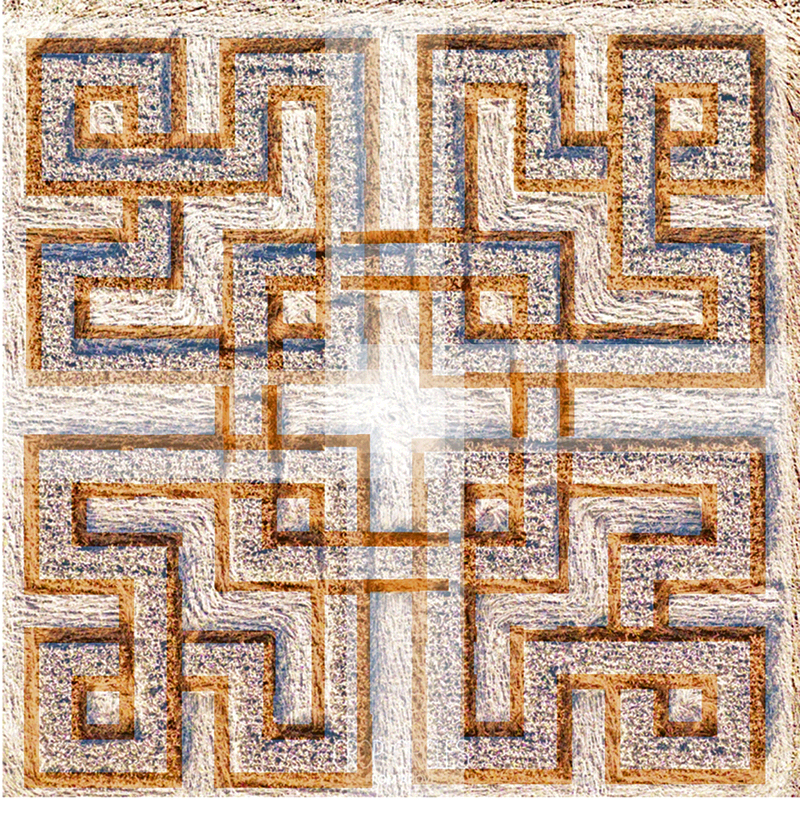
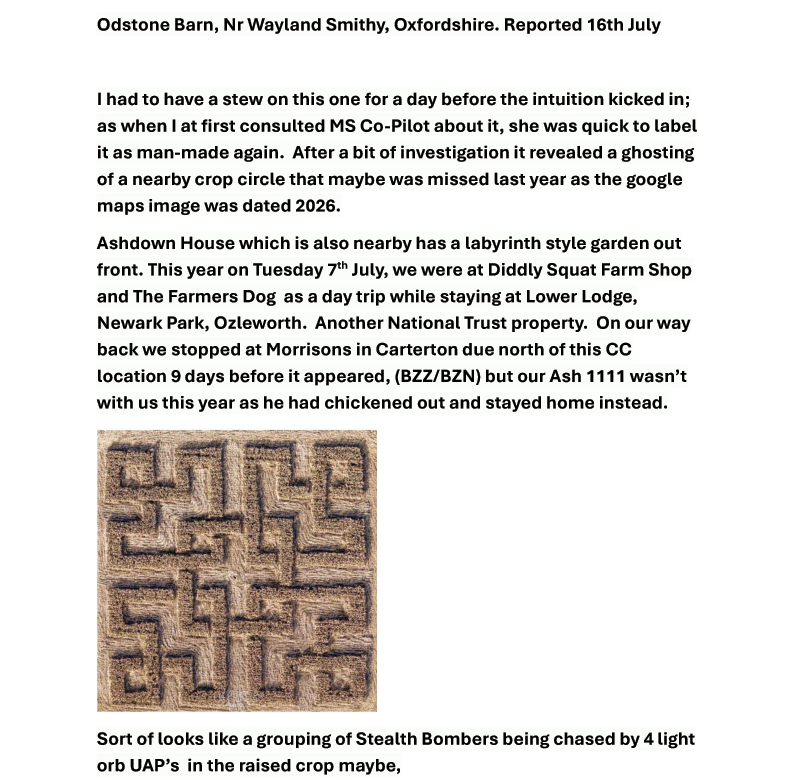
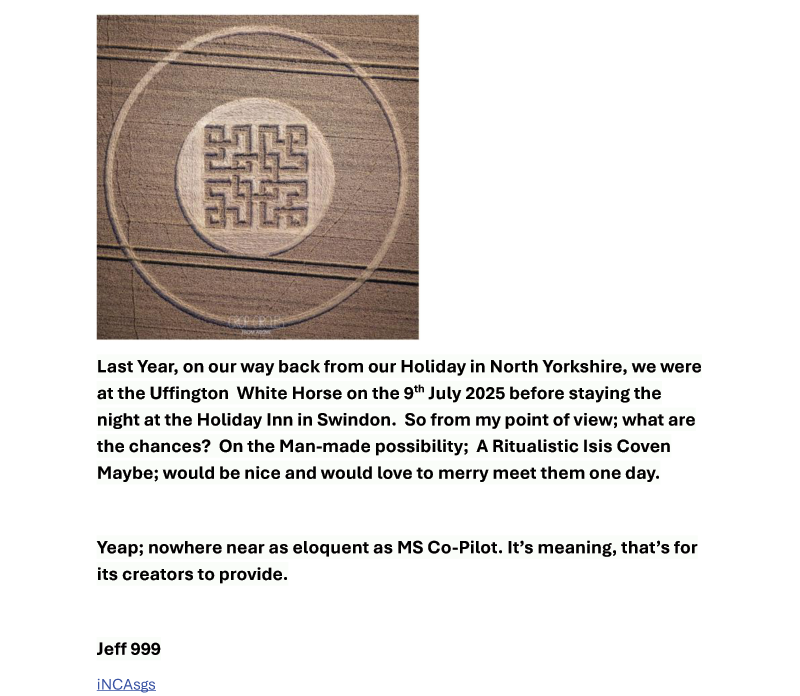
we see at first glance a labyrinth resembling a Celtic knot with
quaternary geometry.
My first impression was that of a
labyrinth.
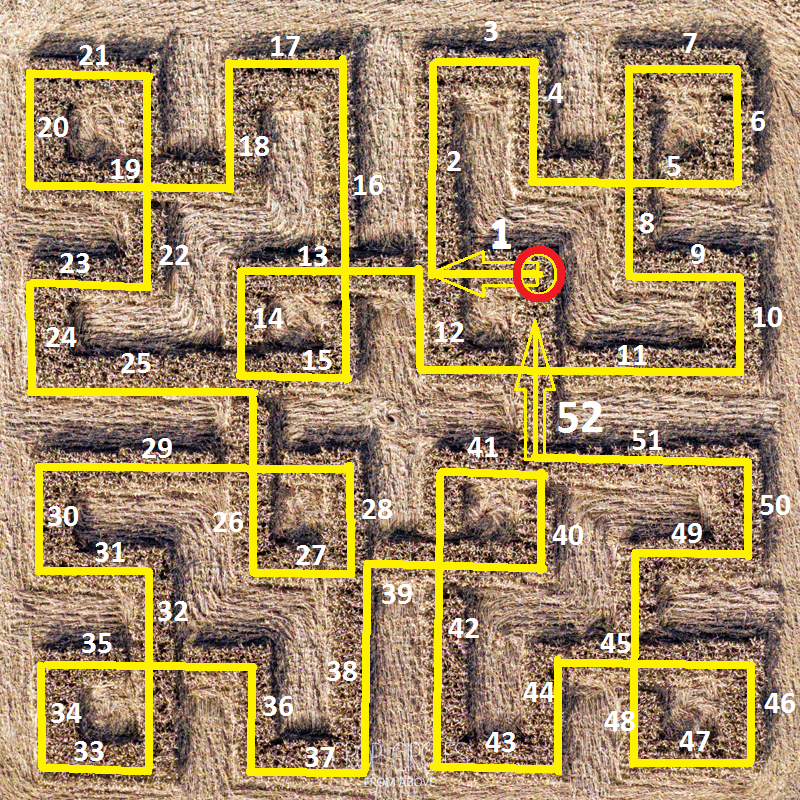
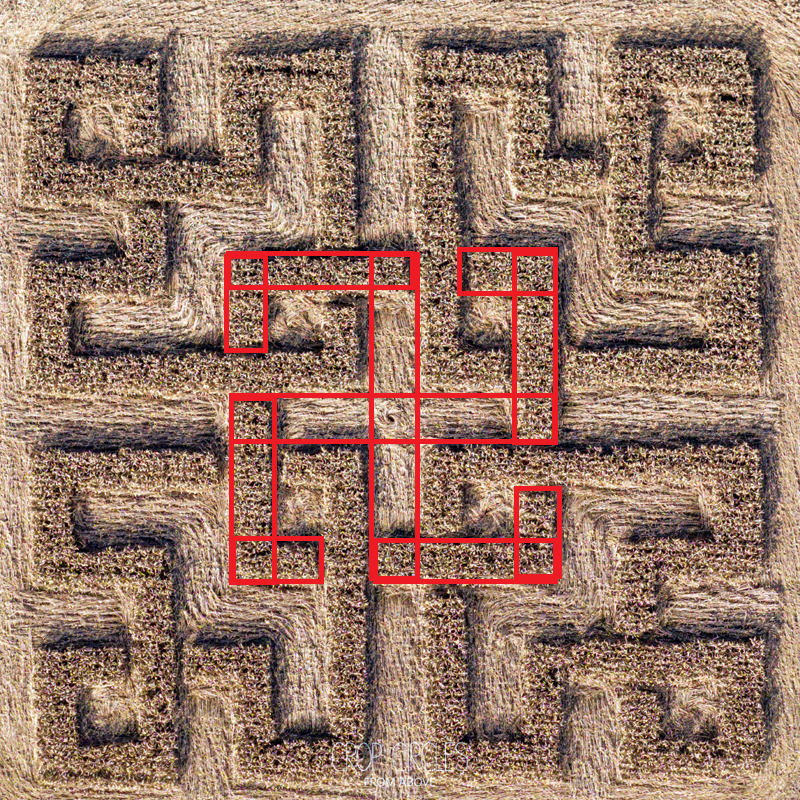
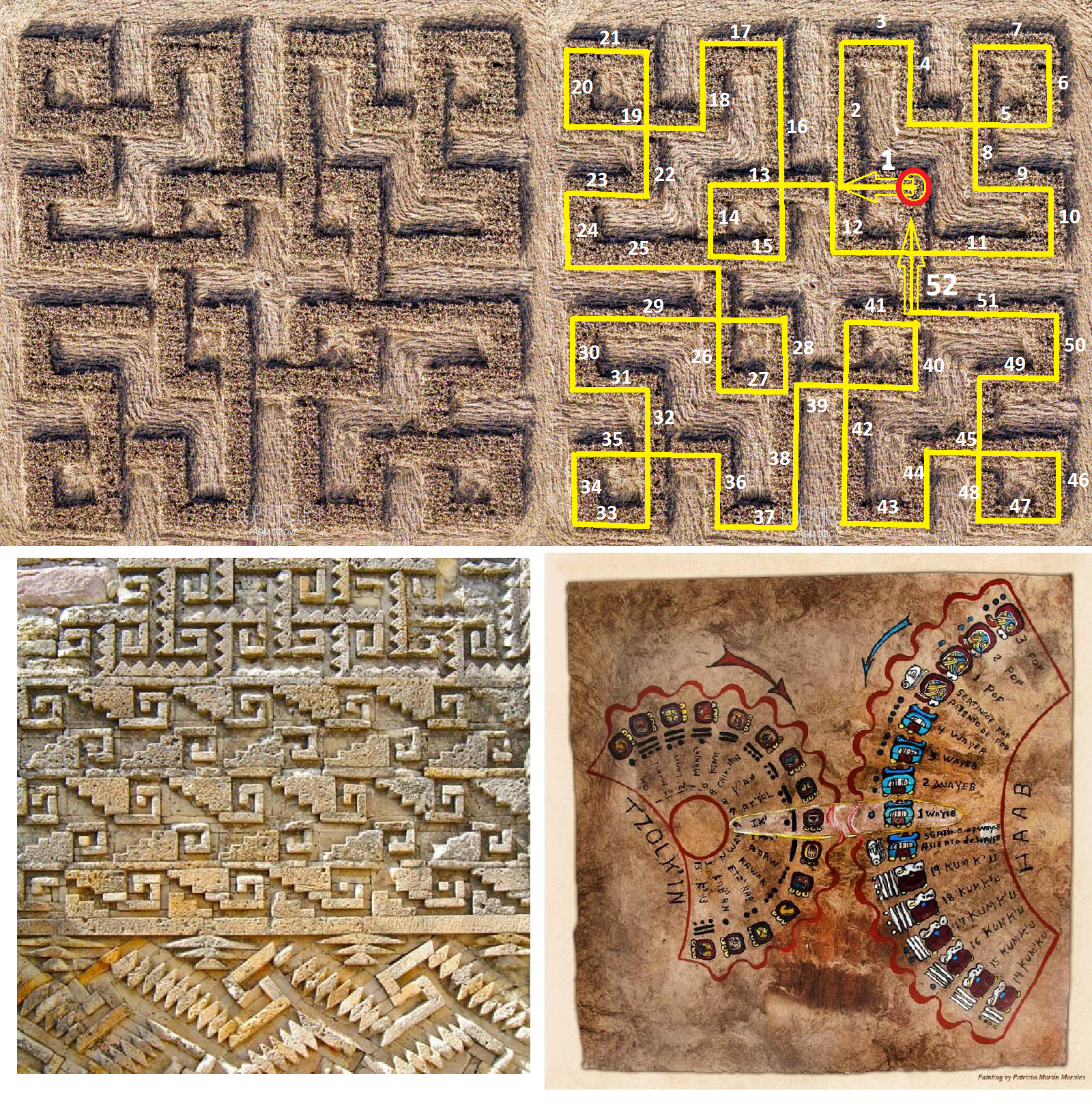
I chose an arbitrary starting point
(red circle) and began following the paths without traversing the same
trail twice. Following the route, I was able to return to the starting
point in 52 movements,
moving from top to bottom and from right to left.
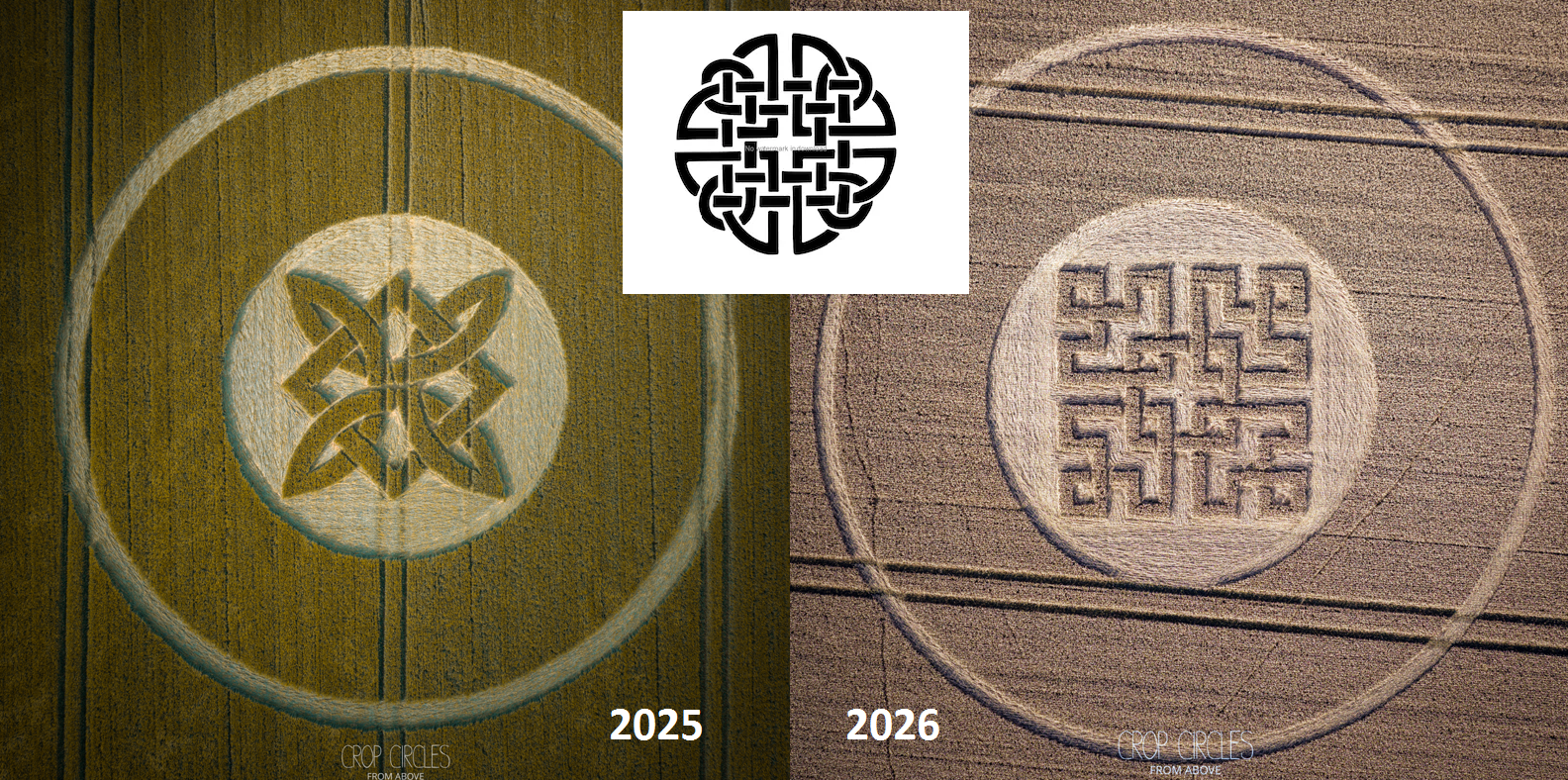
It is a quaternary symbol, a geometry
linking four systems together, as we have already seen in previous crop
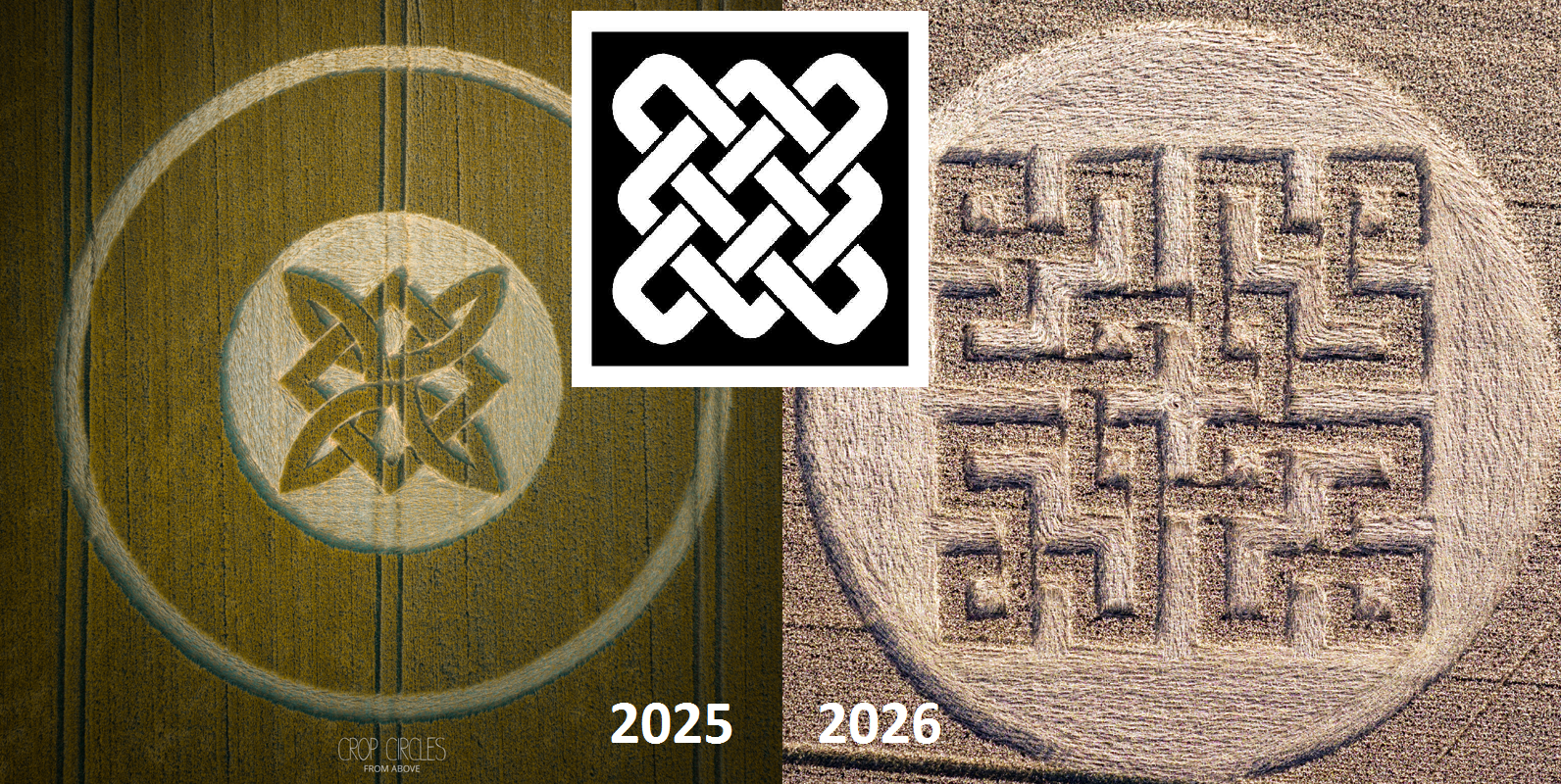
circles (2025, May 15, at The Gallops).
It appears to be an expanded version of
the 2025 idea, continuing a sequence of messages: the 4D
gateway of hyperspace and the key of
the four elements of matter linked
together in a single movement.
The number 52
÷ 4 = 13, and before us stands a
magnificent reflection of Mayan
cosmology. Even a distinct cross
appears highlighted at the center of the labyrinth. In fact, the
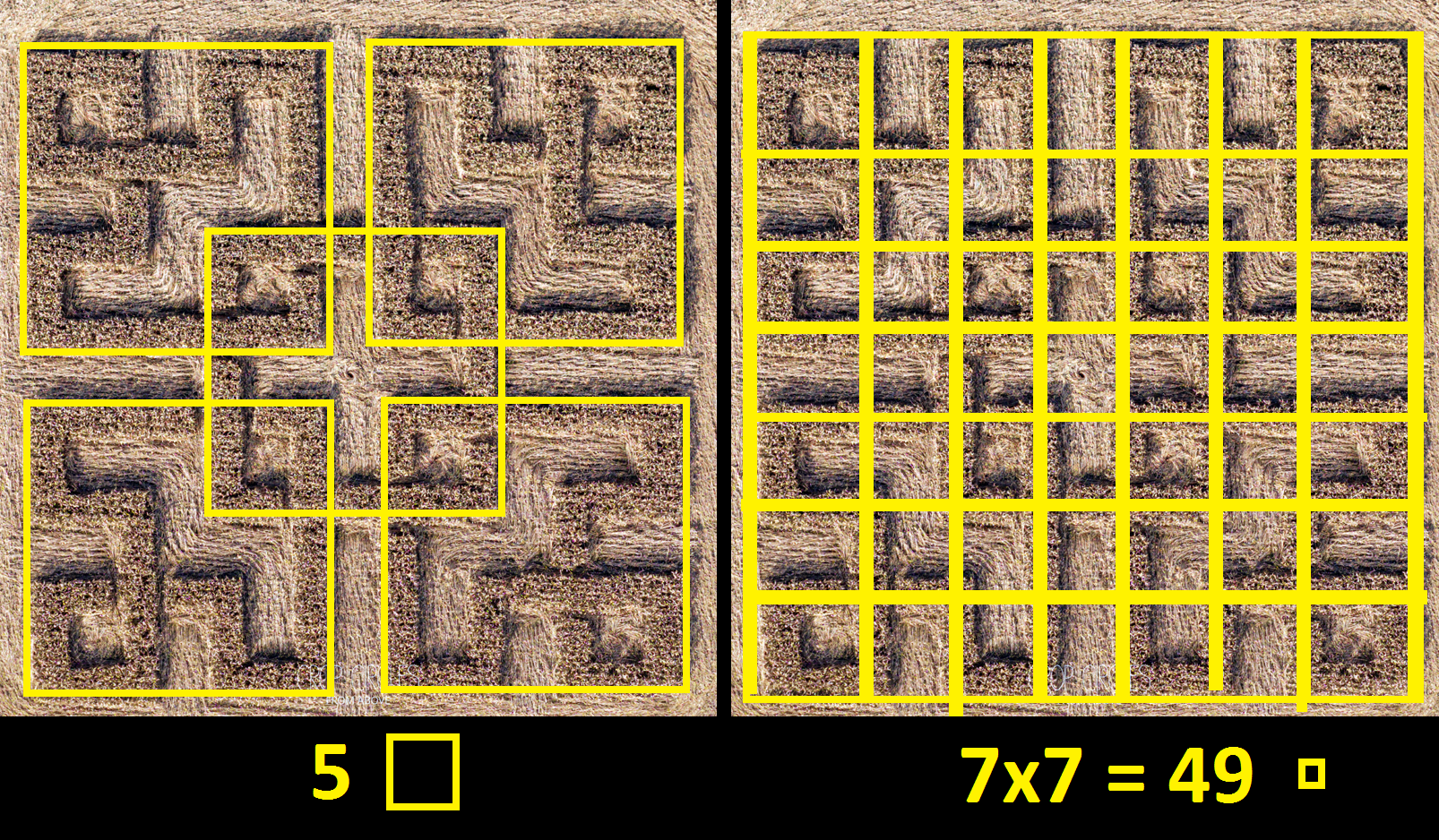
geometric structure of the crop circle is that of a large square
containing five smaller squares, with the four outer squares having
their corners folded into loop-like forms, creating the impression of
links or chains.
The expression 4
× 13 = 52 appears in mechanisms of the
Mayan calendar used to synchronize the cycles of the Earth with those of
Venus.
The cross is also a familiar Mayan
symbol.
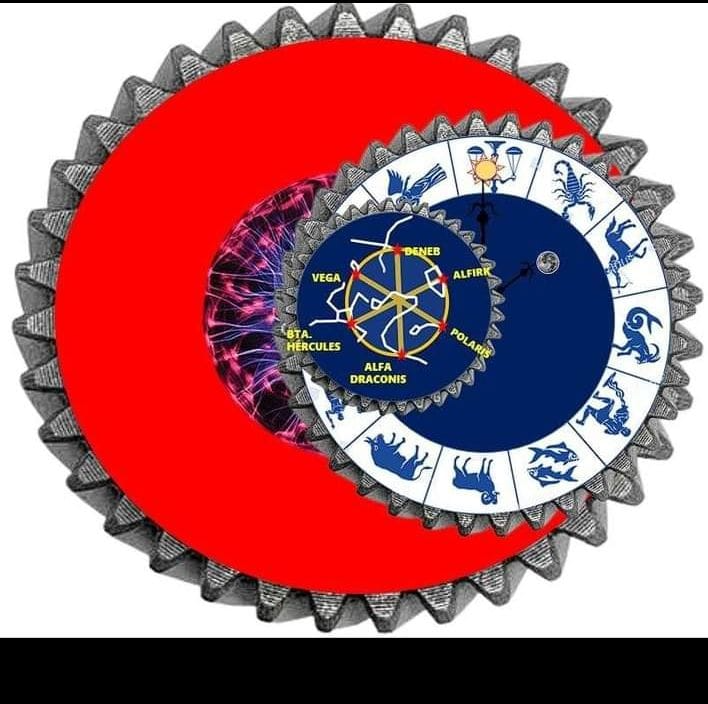
13 × 4
= 52
The relationship 4
× 13 = 52 is one of the best-known
numerical structures associated with the Mayan calendar, appearing
primarily in interpretations of the Tzolk'in,
the sacred 260-day calendar.
The Tzolk'in is formed by the
combination of two cycles:
a) Thirteen
numbers (1 through 13), repeating continuously.
b) Twenty
day names (known as nahuales or
glyphs).
These two cycles progress
simultaneously. Since 13 and 20 are relatively prime, a specific
combination repeats only after 13 × 20
= 260 days.
The expression 4
× 13 = 52 arises because 52
days correspond to four complete cycles of 13 days,
known as trecenas.
Since the Tzolk'in contains 260 days,
it can be divided into:
- Five groups of 52 days (5
× 52 = 260), or
- Twenty trecenas (20
× 13 = 260).
This division into five 52-day periods is used by
some scholars and by several contemporary traditions to organize the
calendar into five "seasons" or energetic cycles, although this
arrangement is not considered as fundamental as the division into twenty
trecenas.
Furthermore, the number 52 has
an even greater significance in Mayan chronology:
Fifty-two solar years correspond to the so-called Calendar Round.
This is because:
- the solar year (Haab')
contains 365 days;
- the Tzolk'in contains 260 days;
- the same combination of a
Tzolk'in day and a Haab' day repeats only after 18,980
days, equivalent to 52
Haab' years.
Thus, the number 52 appears
in two different contexts:
-
52 days = 4 × 13, a subdivision of
the Tzolk'in into blocks of four trecenas.
-
52 years, the great cycle in which
the Tzolk'in and the Haab' coincide once again on the same date
combination.
Therefore, this labyrinth appears to conceal an
identity related to the Mayan calendar, and its coded meaning may be the
deciphering of the key of time in
order to reach parallel dimensions,
especially the fourth dimension.
The idea of a complete great cycle is also suggested here (the year 2026,
with the value 26 = 52 ÷ 2).
Other Numbers
A larger square containing five smaller
squares is laid out on a 7 × 7 grid,
producing 49 quadrilateral cells.
Once again, the 7/7 pattern (the
duplication of seven) appears.
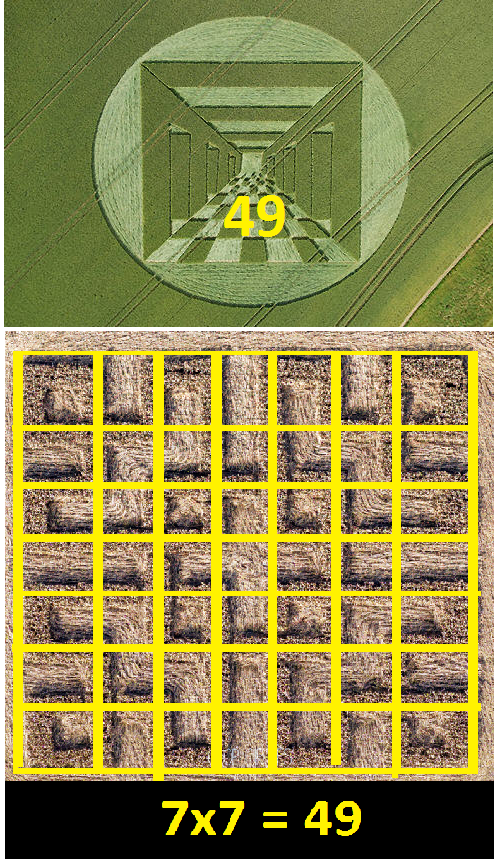
This reminded me of the crop circle of June
28, 2007, depicting a secret chamber
resembling Leonardo da Vinci's Last
Supper, featuring seven doorways,
seven ceiling beams, and a floor divided into 7
× 7 squares.
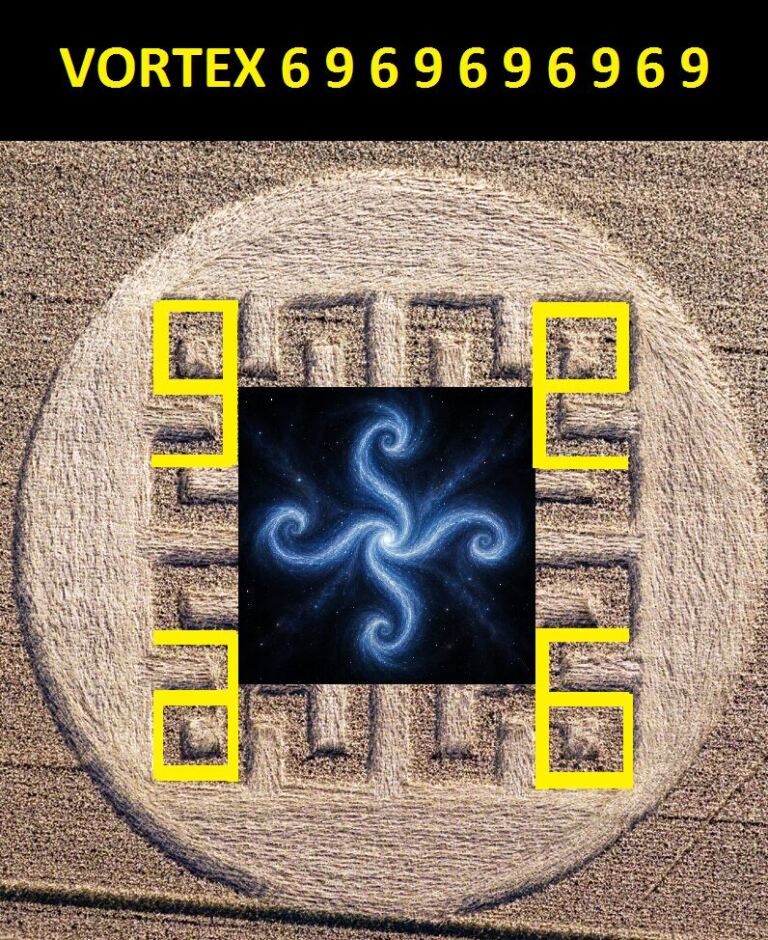
Within the labyrinth's structure, I
identified the numbers 6 and 9 at
its extremities and also around the center of the formation, surrounding
the cross.
Numerically, 6/9 symbolizes Yang
and Yin, representing the flow of
complementary polarities. This corresponds to the same concept as the 7/7
duality observed in previous crop
circles, where 7 represents
the maximum scale of energy, while 2 symbolizes
the polarization necessary to generate flow and movement.
It evokes the image of serpents moving
along the labyrinth's paths, reminiscent of the paired serpents found on
pre-Columbian monuments such as the Pyramid of Kukulkan, the Gate of the
Sun at Tiwanaku, and the Aztec Sun Stone.
When the crop circle is rotated, the
numbers 6 and 9 alternate
with one another. In Kabbalah, Six corresponds
to the order of the Sun,
while Nine corresponds
to the order of the Moon.
Sun and Moon... the solar
eclipse of August 12, 2026... portals
and alignments... the movement of the energy of the four classical
elements merging into the fifth element—ideas that seem interconnected
throughout the message conveyed by this series of crop circles.
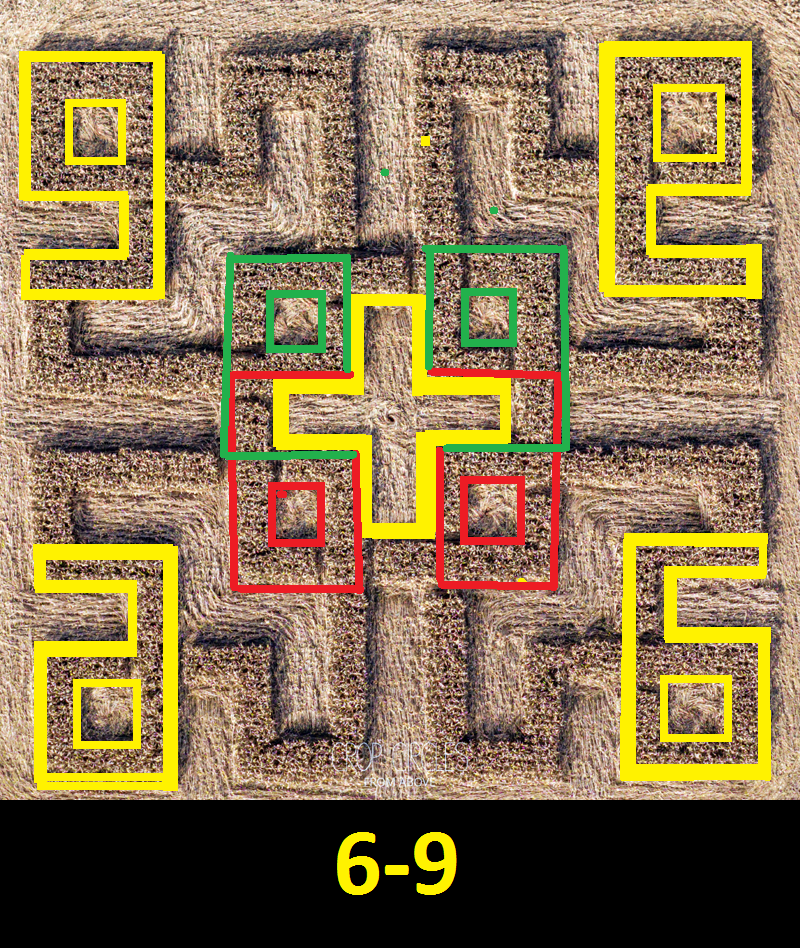
Within the image, the number 6 appears
twice, and the number 9 also
appears twice, alternating (6 becomes 9, and 9 becomes 6) as the image
is rotated.
Indeed, the 6/9
motif resembles the movement of the
twin serpents found on those pre-Columbian monuments, combining the
symbolism of calendars and portals.
A vision of Mayan cosmology extending
far beyond what contemporary science presently recognizes.
(6 +
9) = 15
(15 ×
4 = 60)
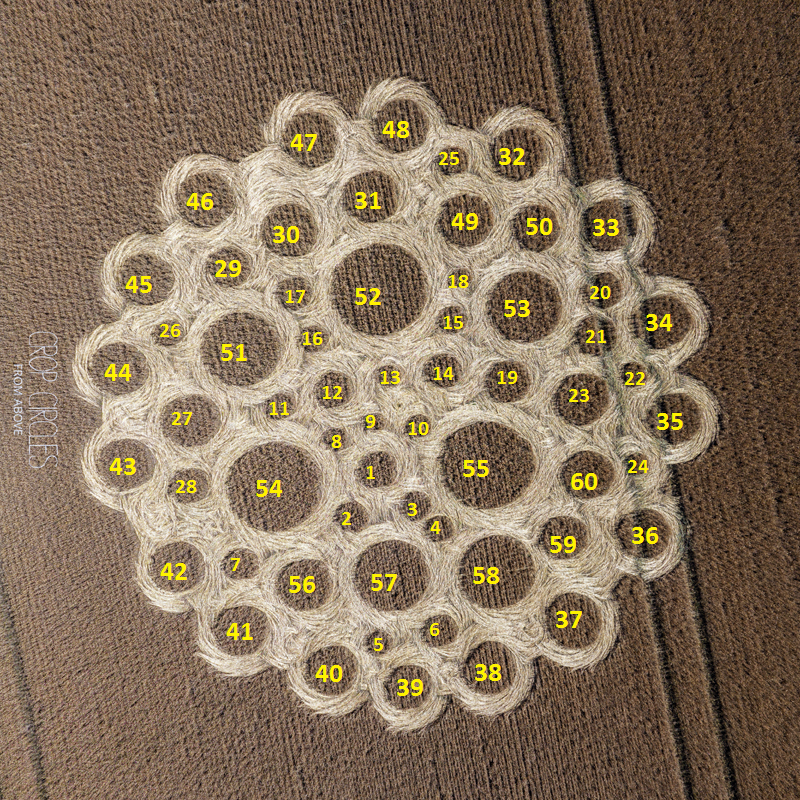
Interestingly, 60
circles of varying sizes were
incorporated into the enigmatic Zeals
Knoll crop circle on July
5, 2026.
P.S.: A swastika can be derived from
the intersecting lines at the center of the crop circle, reinforcing the
concept (4x13 = 52) of the movement of energies (the four elements and
the fifth element) in the design of an energy key to the
fourth-dimension gateway—a concept widely explored in the past under the
name VRIL.
JP —
July 16, 2026
The
Mayan Calendar Key to Solving the Labyrinth Enigma
On the same day, on my profile, I
requested crop circles containing coded messages, as in the past, and
they appeared that very same day.
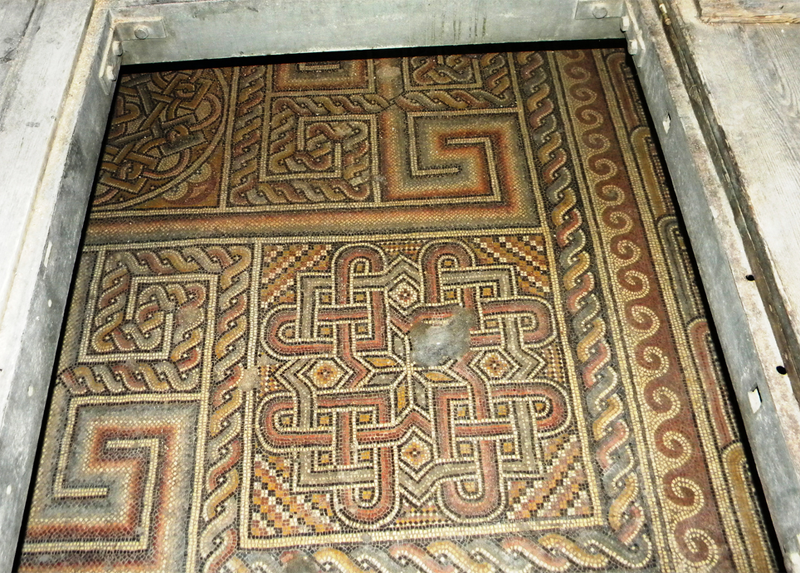
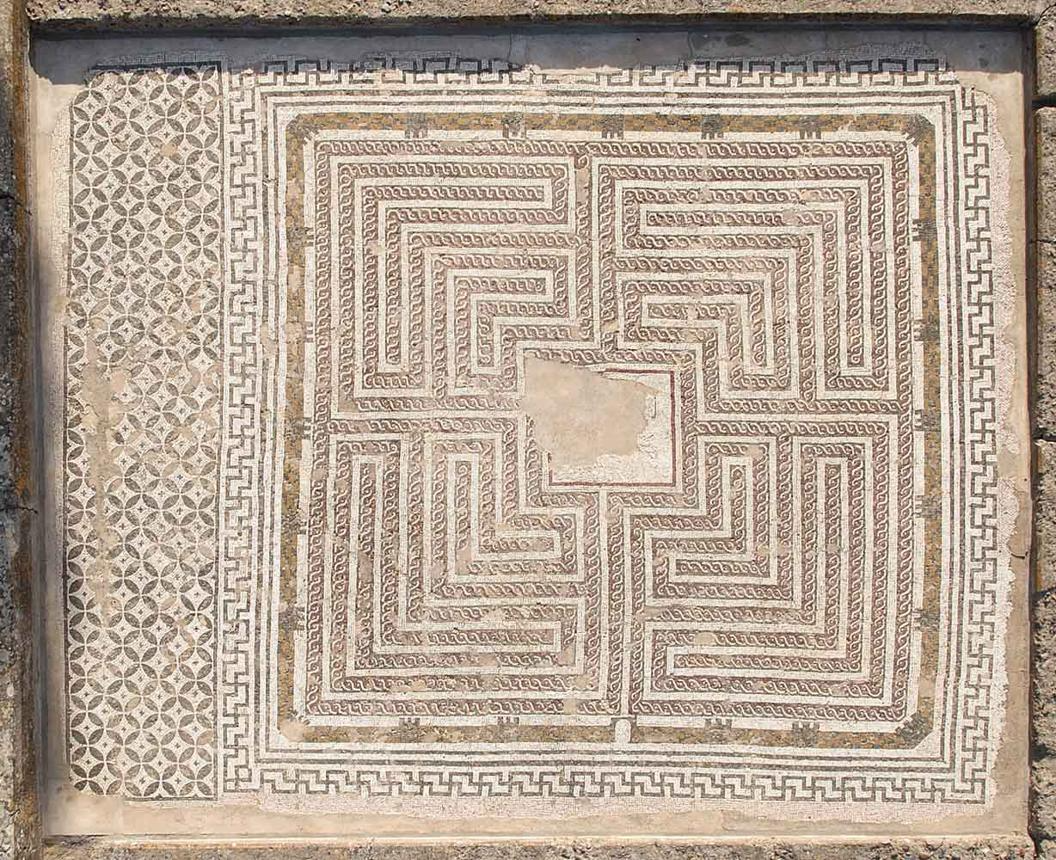
Beyond its Maya/Pre-Columbian
ornamental style, this crop circle strongly resembles the design of the
Etruscan labyrinth of Tragliatella (7th century BC).
Time itself is the greatest labyrinth
imprisoning all souls incarnated in this world, and every turn of that
labyrinth is one cycle laid upon another, like the links of a chain that
no one can break—or a labyrinth from which no one can escape.
The key to time embedded in the Mayan
calendar, centered on the formula
13 × 4
= 52, offers a solution within a
cosmology that seeks to synchronize all cycles into one supreme cycle,
thereby revealing the gateway to the Day
Out of Time (July 26).
If the heavenly bodies govern the
cycles, and if the combined cycles govern time itself, then the key to
the mechanism must necessarily be related to them.
The principal code presented here
connects the cosmology of the Mayan calendar with the opening of portals
into the fourth dimension. This idea is illustrated in a remarkable way
by the Aztec Sun Stone, where the glyph 13
Acatl appears above the two
serpents—the eternal flow of time in constant motion—and above the
concentric circles centered upon the Sun god Tonatiuh.
When the mysterious alignment occurs, Tonatiuh opens
his mouth and extends his tongue,
symbolizing the activation of the Sun's energies at the end of each
Great Race. The four previous races are represented by the four suns
surrounding Tonatiuh at the center.
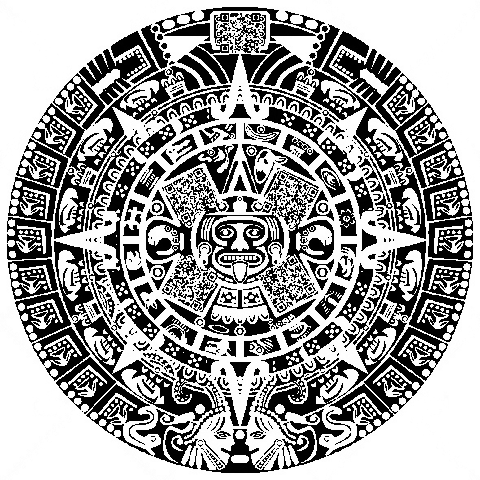
That 13
Acatl glyph at the top—the thirteenth
seal of the Mayan calendar—is closely associated with the concept of
tunnels or alignments, through the symbolism of the reed as a conductor
of water. It expresses the understanding of time as energy in motion,
and that this current can be redirected, revealing passages into
dimensions that exist beyond time itself—the fourth dimension.
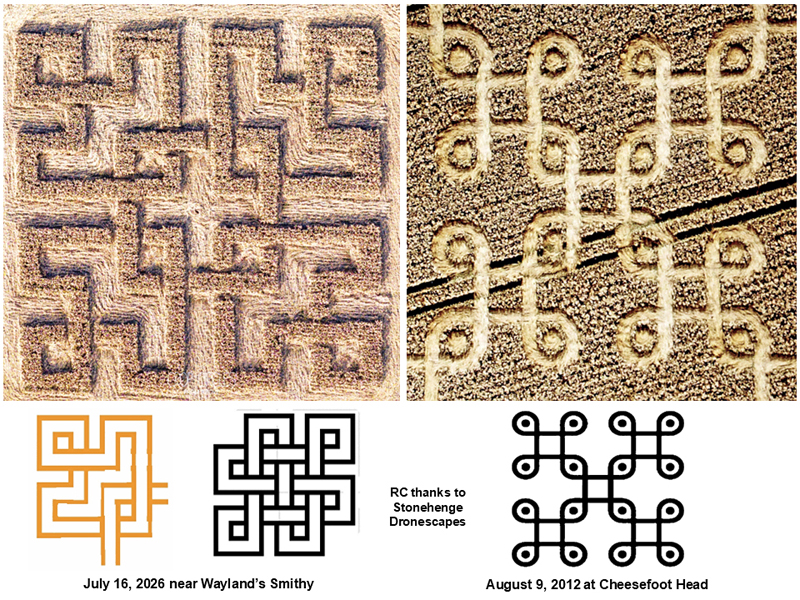
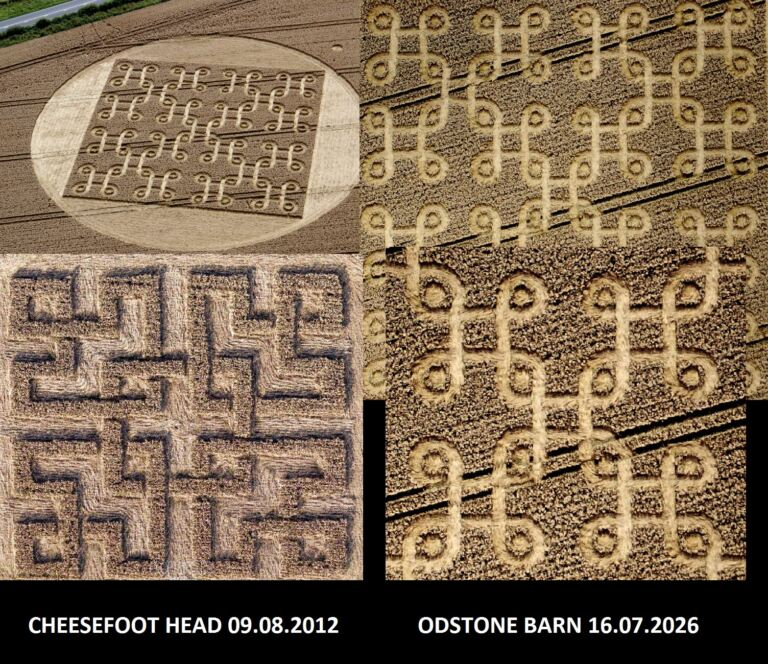
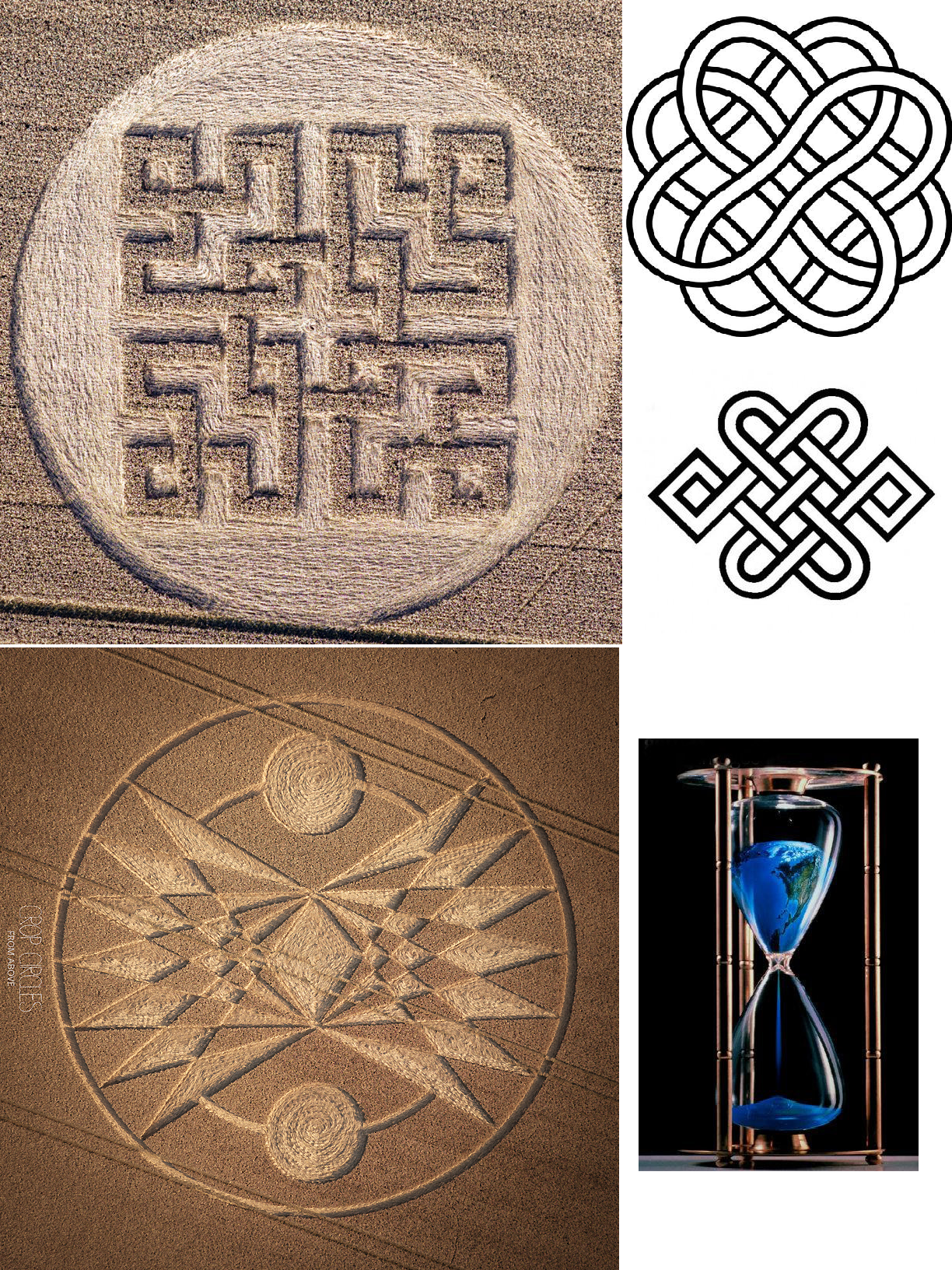
There is also a striking visual and
structural relationship between yesterday's crop circle at Odstone
Barn and a structurally similar
formation at Cheesefoot Head from 2012—the
year marking the completion of the Mayan Long Count calendar—suggesting
a solution to the labyrinth represented here.
Before continuing, a few general
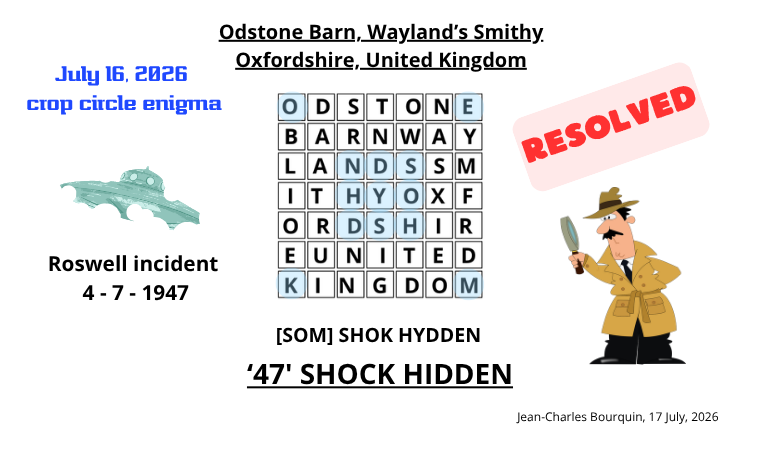
remarks about Odstone Barn,
the location of the crop circle.
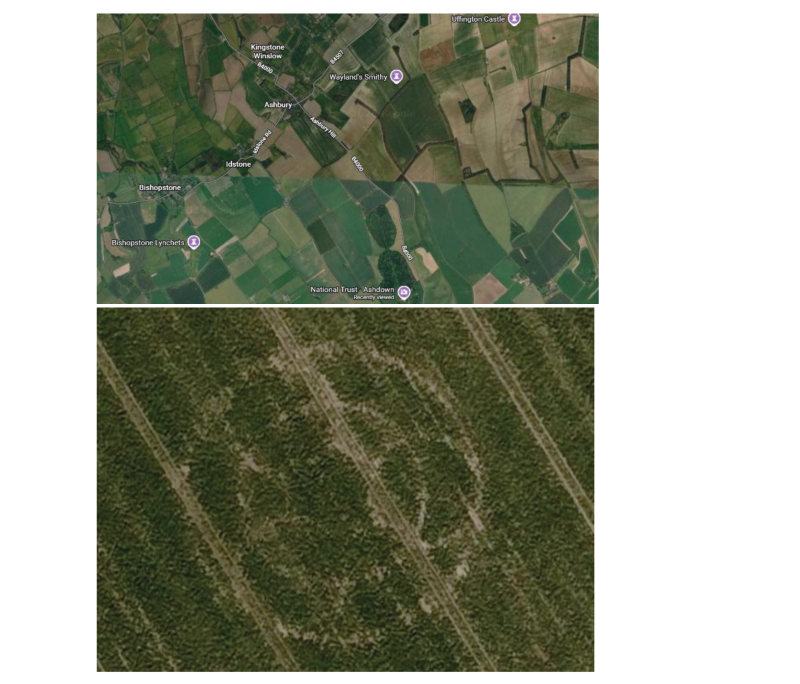
Nearby stands the megalithic tomb of Wayland's
Smithy, approximately 5,600
years old.
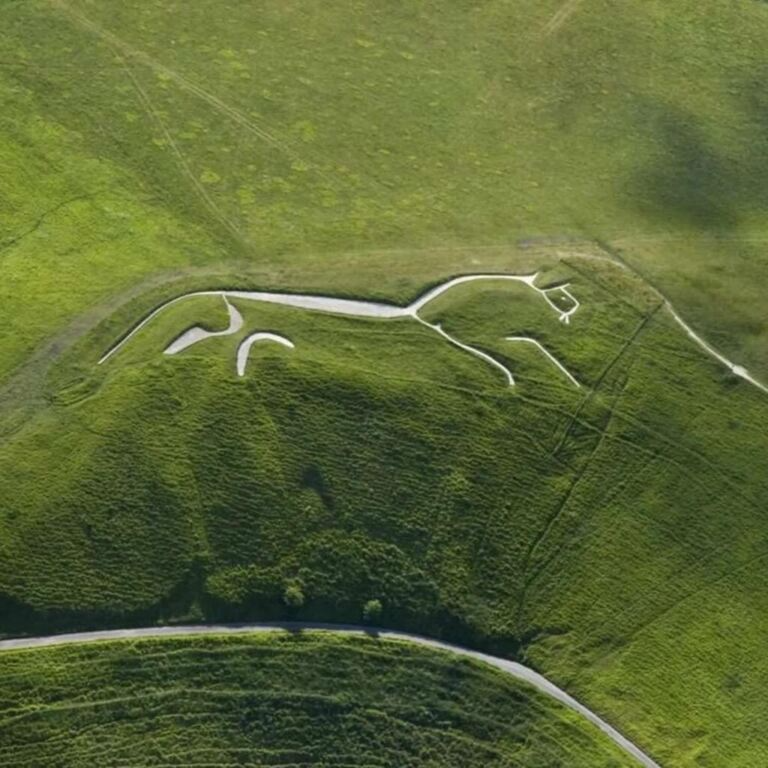
It is also close to the hillside where,
once again, stands the Uffington White
Horse. For the third time, we find a
crop circle appearing near one of these ancient monuments, of which many
are scattered throughout England.
The Uffington
White Horse is one of England's most
extraordinary prehistoric monuments. It is a gigantic geoglyph carved
into the slope of a chalk hill, formed by trenches filled with white
chalk to create a stylized horse approximately 110
meters long. Dating from the late
Bronze Age or early Iron Age—roughly between 1380
and 550 BC—it is regarded as the
oldest White Horse monument in Great Britain.
Odstone Barn thus becomes part of a
remarkable corridor of prehistoric monuments.
Within only a few kilometers are found:
- Wayland's Smithy
- White Horse Hill
- Dragon Hill
- Uffington Castle
- The Ridgeway
The Mayan Calendar Code
Everything seems to be pointing toward
the coming July 26,
because this is the Green Day,
the Day Out of Time in
the Mayan calendar, according to the same numerical value of 52 applied
to the solar year:
52
weeks = 52 × 7 = 364 days (+1: the Green Day, the Day Out of Time,
completing the 365-day year).
The four waves of Earth's elemental
energy—the four classical elements—intertwine and spiral into a vortex
centered upon the Fifth Element, VRIL,
represented by the solar swastika associated with the INRI inscription
of Christ's Cross (which also appears at the center of the crop circle).
This symbolizes an alchemical Hermetic code for the Fifth Element
governing all transformations of matter.
Planetary Alignments
Once again, the crop circle appeared
alongside significant planetary alignments (on July
16 and 17), the most important being
the Moon–Venus conjunction in Virgo.
Many people speak of a planetary
alignment on July 17, but this is technically inaccurate. A planetary
grouping is not the same as a planetary alignment. The bodies truly
aligned in the sky on that day are the Moon
and Venus in Virgo (within the
constellation of Leo).
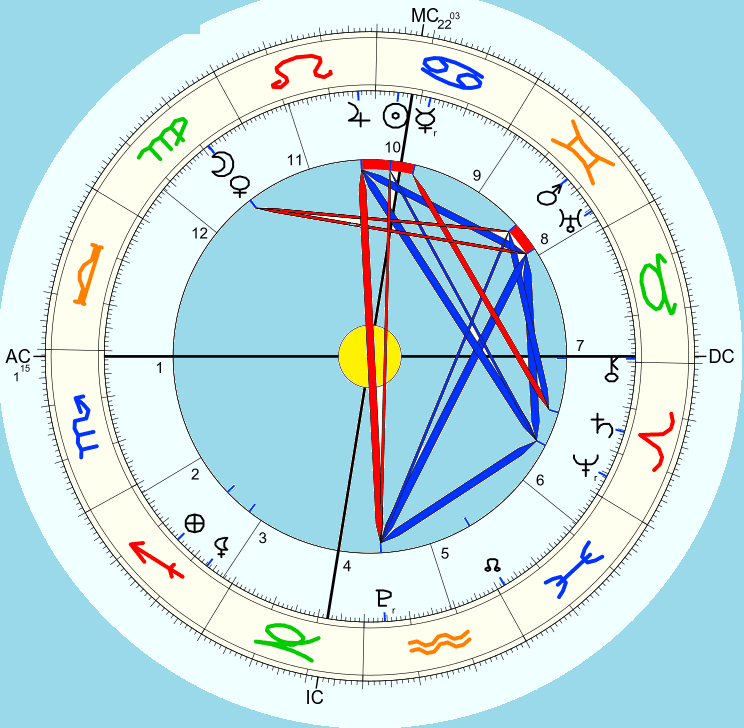
What is particularly noteworthy,
however, is the formation of a half-hexagon among
several planets:
Jupiter (Leo) // Mars–Uranus (Gemini) // Neptune (Aries) // Pluto
(Aquarius)
This is an exceptionally powerful and
harmonious configuration because of the geometric relationships
involved—primarily sextiles and trines.
As discussed previously, planetary
alignments (such as the upcoming August
12 total solar eclipse) have often
been associated with the generation of dimensional portals.
Thus, an intriguing clue points toward
the coming July 26.
Indeed, in previous years, the period
between July 25 and 26 has
repeatedly produced remarkable and highly significant crop circles.
This may well be the occasion for a new
installment of the message to be delivered to the world.
o-labirinto-do-tempo-no-novo-crop-circle-2026
JP —
July 16, 2026
The
Concept of Time and the Infinite Knot
This square Celtic-knot-style crop
circle bears the pattern of an infinite
knot, that is, a sequence of
interwoven folds with neither beginning nor end. I traced 52
continuous paths through this design
without repeating a single route, starting from an arbitrary point
(1–52).
The infinite knot, in any form, is a
geometric or artistic motif made from a single continuous line that
weaves back upon itself, with no apparent beginning or end. Across many
cultures, it symbolizes continuity, eternity, unity, and the cycles of
existence.
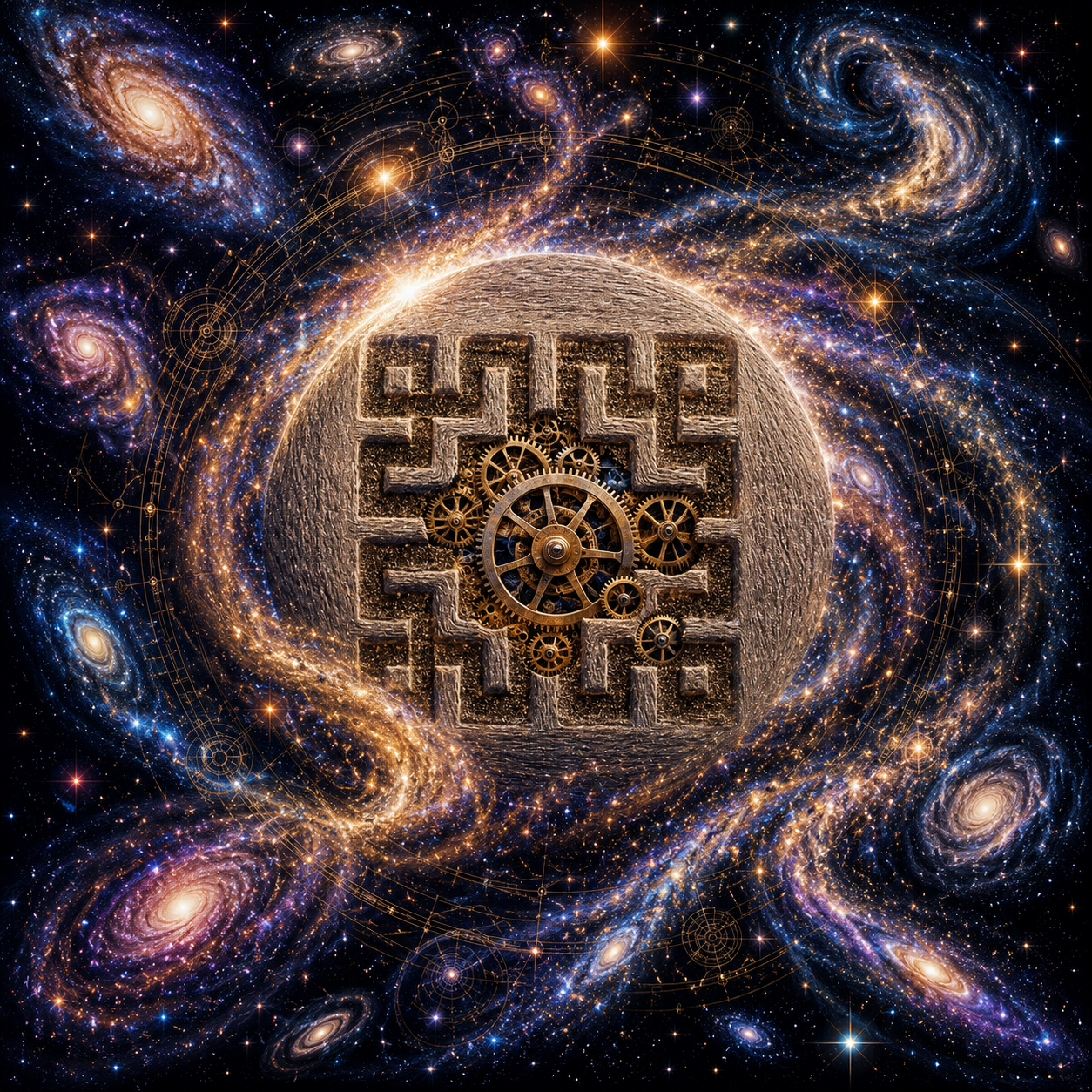
This is the very concept of time: when
one day ends, another begins immediately afterward.
Furthermore, according to ancient Mayan
cosmology, time is a parallel dimension expressed as energy in motion
beneath the combined, interwoven cosmic cycles. This is another
fascinating concept of time associated with the symbolism of the
infinite knot.
Modern Einsteinian physics associates
time with the fourth dimension,
which is a remarkable insight. Time is dimension; it is energy in motion
(cycles). But if cycles are closed upon themselves (the infinite knot),
where and when can they be broken?
Where is the Door
of Time, the Green
Day, that grants access to the
parallel dimension where time no longer revolves as it does here on the
3D plane?
Every door requires a key, and that key
was revealed on July 11, 2026,
at Roundway Hill.
The
Code 72: two waves (2) of energy at
their highest degree (7) collide with one another, creating a central
rupture that identifies a portal.
The
Time Code 72
Yes, we live confined within the 7-and-2
matrix of time (the seven days of the
week, with days and nights succeeding one another).
The Earth positions itself on one side
relative to the Sun, and that is day. The same Earth positions itself on
the opposite side relative to the Sun, and that is night.
The Mayan calendar and the highly
advanced cosmological concepts of the pre-Columbian peoples approached
the question of time far beyond the limited metric of the official
Gregorian calendar.
The Door of Time and the scissors that
sever the infinite knot are connected to a mechanism of energy capable
of linking us directly to the fourth dimension.
This is what the Maya taught, and what
numerous crop circles have been reaffirming for decades.
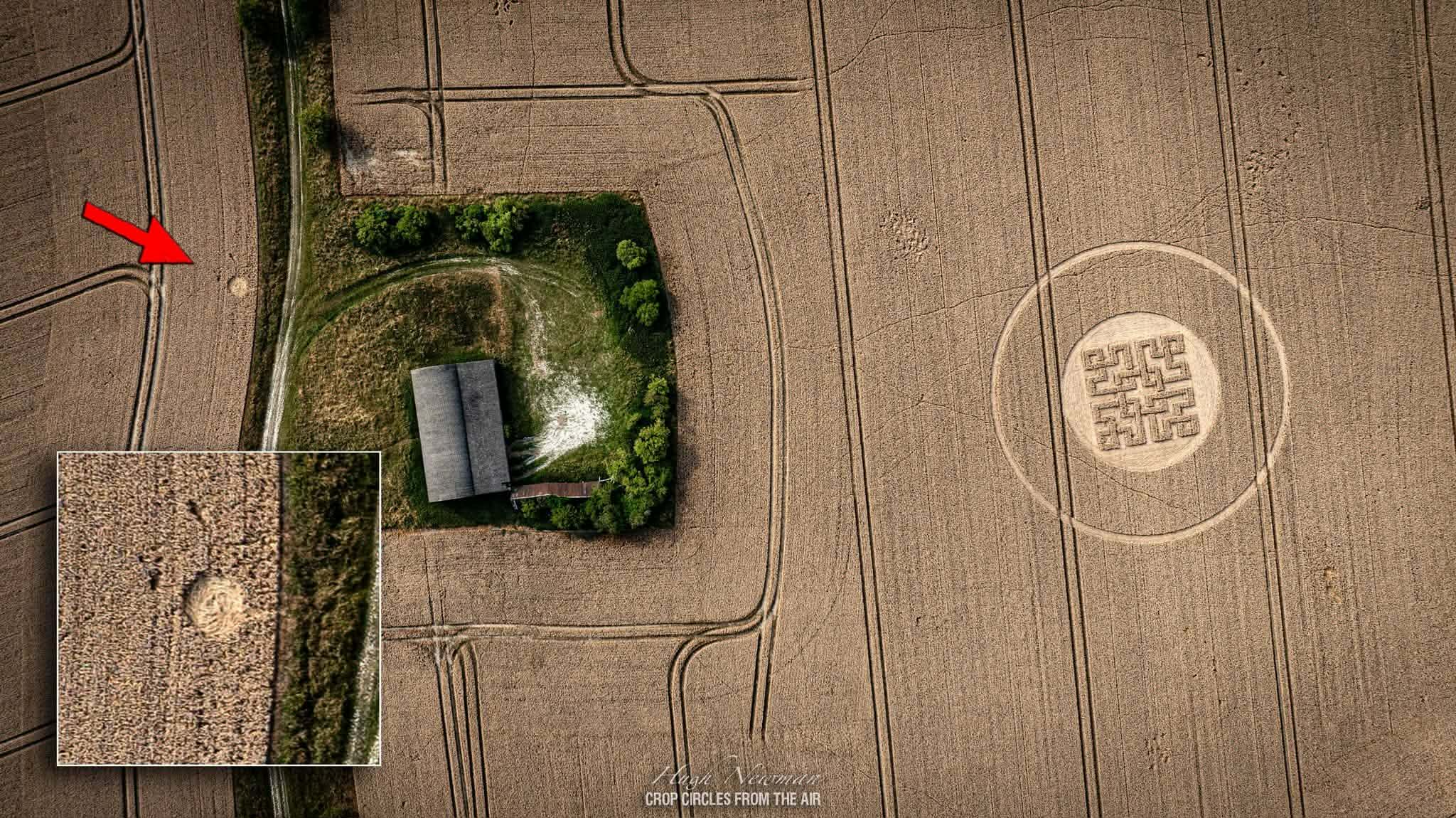
P.S.
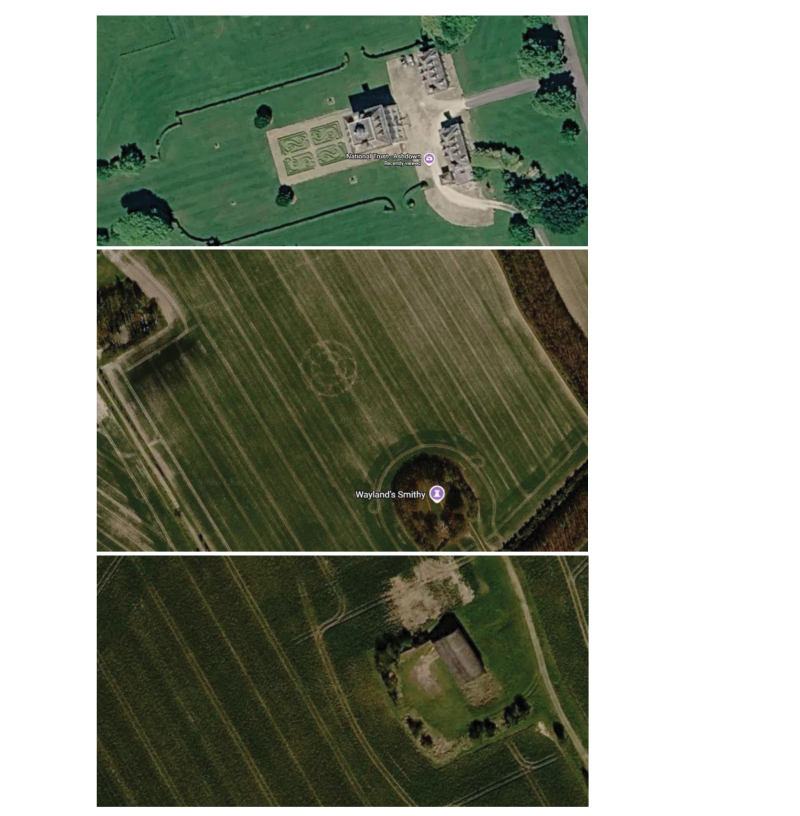
The Odstone Barn crop circle appeared
beside a local farm building, and a small crop circle was added to the
landscape.
Notice that the crop circle and the
barn are aligned, suggesting that an additional layer of meaning has
been incorporated into the message.
What is kept inside a farm barn?
Planting tools, vehicles, fertilizers,
agricultural supplies, and perhaps seeds.
Everything related to the crops and
cultivation being carried out on that land.
The first idea conveyed by the message
concerns the care that the Earth's spiritual
harvesters are taking with the seeds
that have been planted and are already bearing fruit—seeds they are
preparing to harvest according to the Father's command.
This interpretation is consistent with
the crop circle's themes of time, cycles, portals, the arrival of new
energies, and the coming of the "King."
For the Angels sent by Him to the four
directions of the Earth for the spiritual harvest move and flow through
the same four elemental energies that are linked together like an
infinite knot, operating through the departure and return of the fifth
element, their original matrix.
JP —
July 17, 2026
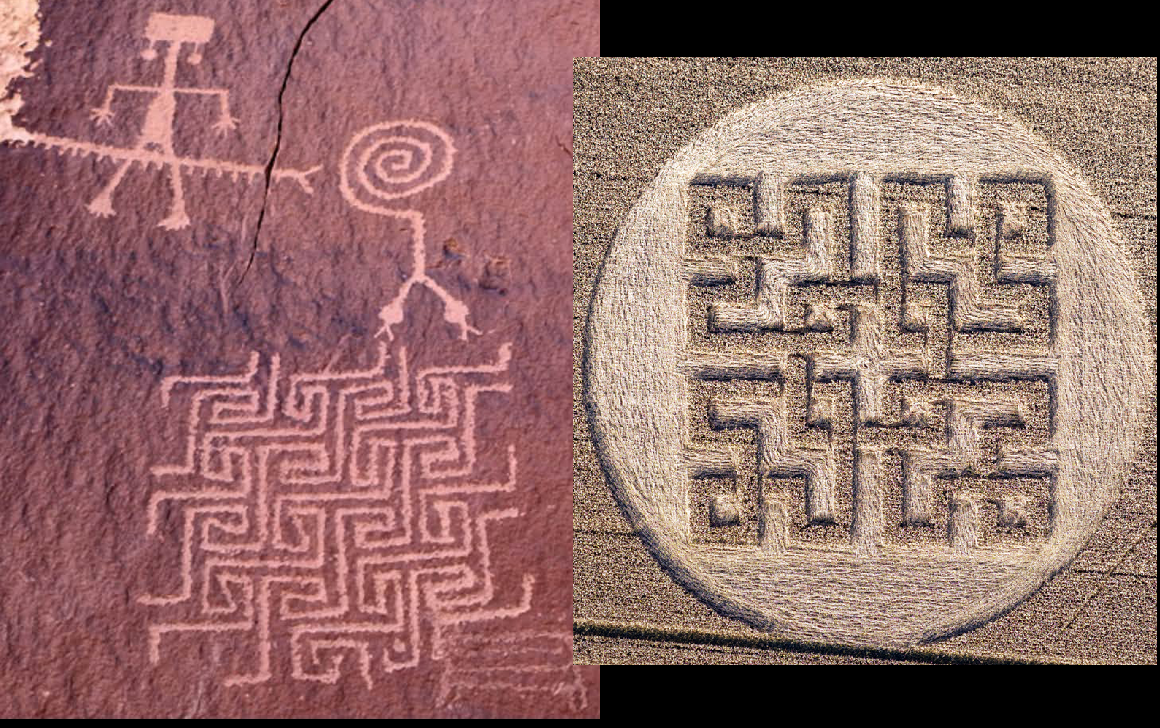
Connections: The 2026 crop circle and the
message of an ancient petroglyph
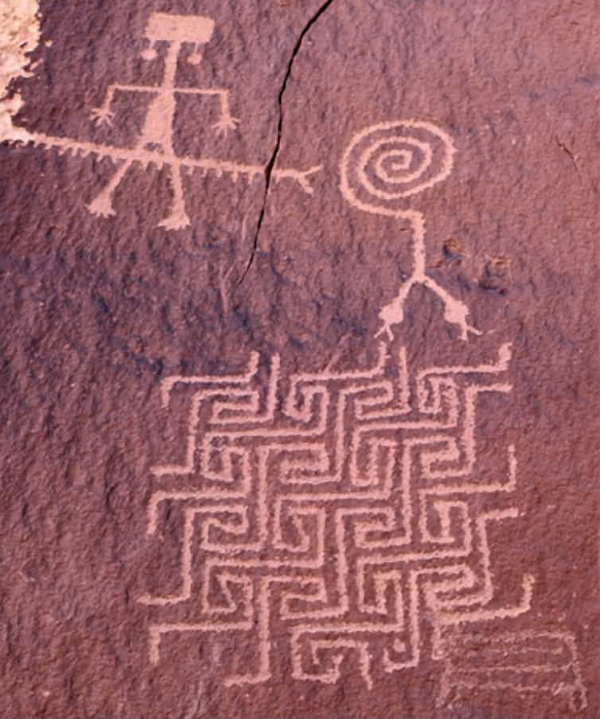
This "Labyrinth" petroglyph in House Rock Valley,
Arizona, USA, features a maze remarkably similar to the one depicted in
the crop circle that appeared at Odstone Barn, UK, on July 16, 2026.
Petroglyphs of this type are common across the Americas—artistic
expressions where early peoples recorded their messages, myths, and
visions of the heavens. They served as the books and paper of their
time, a medium for immortalizing their teachings and sightings.
Here, we see a strange entity—an alien or perhaps a shaman-priest of
that culture—standing before the labyrinth alongside a coiled,
two-headed serpent. This is the central mystery, seemingly linked
directly to the labyrinth: every labyrinth implies a riddle, and the
riddle here undoubtedly lies in this coiled, two-headed snake.
The spiral is a universal symbol of time in motion, representing cycles
and the transformations they entail. The serpent also alludes to
cyclical transformation, particularly through the symbolism of its
frequent shedding of skin. Yet this serpent has two heads, representing
the polarization of energy and the very concept of time—day and night,
for instance.
Interestingly, in a completely different
context—ancient Crete, the Greek island famous for its labyrinths—the
symbol most often associated with them was the double-headed axe (or
double-bladed axe).
In fact, the word "Labyrinth" derives from
this; the symbol of the double-bladed axe is known as the *Labrys* (or *Labrys*
in Greek).
It was the principal sacred artifact of the ancient
Minoan civilization on Crete, frequently associated with female deities
and religious rituals. Like all the heroes of old who had to enter the
labyrinth armed with special weapons (such as Theseus and the Minotaur
in the Cretan labyrinth), the double-bladed axe connects to this
two-headed serpent as a weapon or mechanism necessary to conquer the
labyrinth.
And the greatest labyrinth of all has no walls or
structures; it is invisible, and it imprisons all beings within its
endless cycles.
Time.
JP —
July 21, 2026
|