|
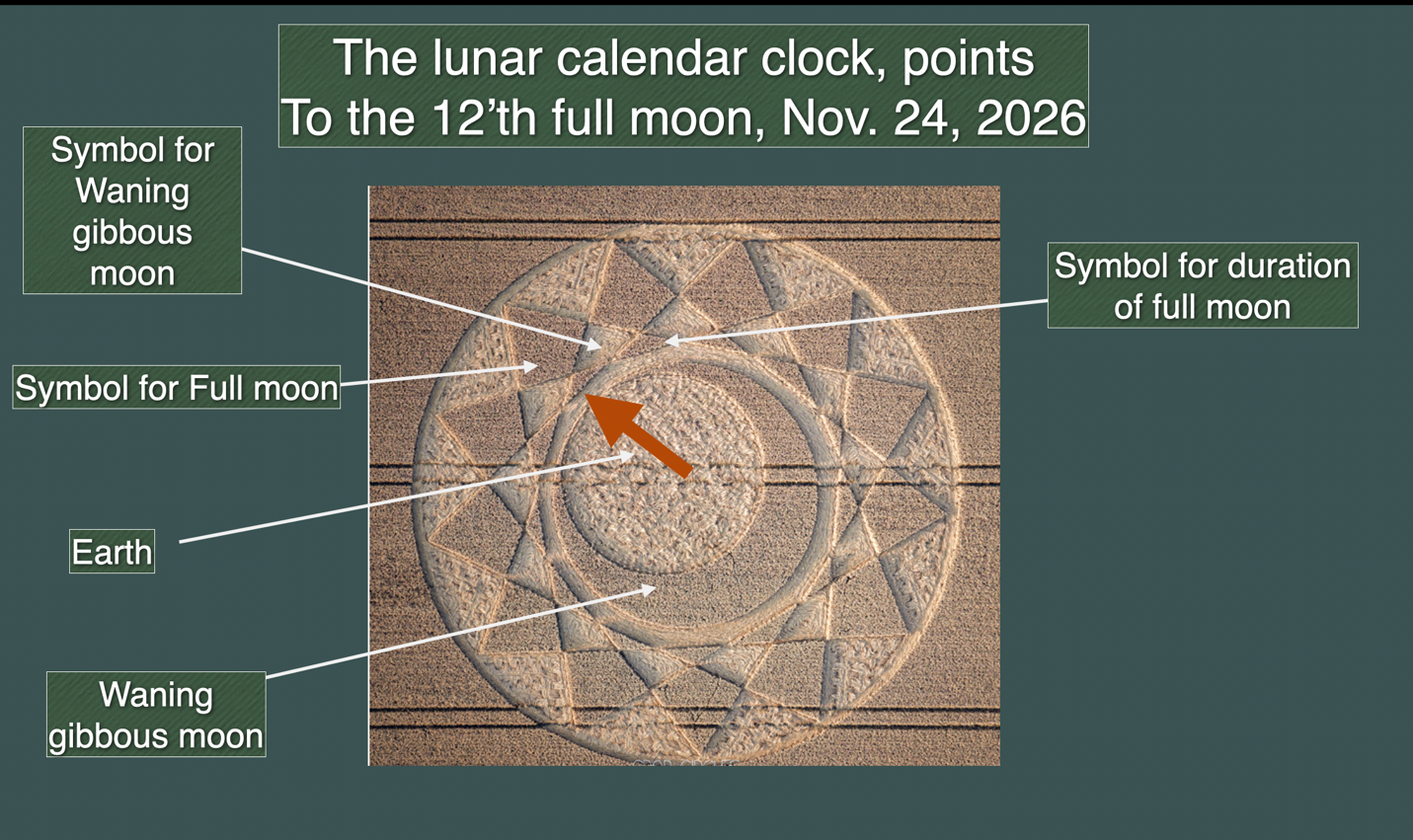
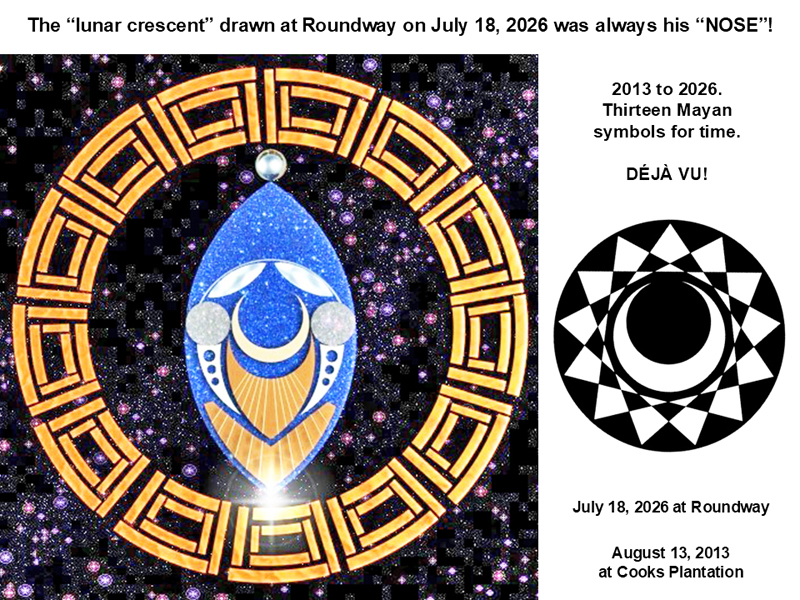
Roundway Hill (1) and (2)
The fact that these two crop circles
came down in the same field precisely one week apart is certainly no
coincidence; it's deliberate. And thus, observers face an obvious
synchronicity; or put another way, there's an overall meaning to the set
of two, which cannot be derived by isolating one from the other — the
meaning must integrate and sum the set of two crop circles.
So, what are we looking at?
Before addressing the question
directly, perhaps a little humility is in order: our civil calendar,
which recognizes a year of approximately 365.25 days, divided into 12
months of 7-day weeks, is a nasty piece of work. Other calendar systems
have been used by other cultures, at other times, for a variety of
different purposes . . . which no doubt presents the circle-makers with
a problem.
In communicating with the denizens of
earth, where the circle-makers' clever artful constructions appear,
which calendar system do they adopt:
our system, messy and imprecise as it is, or an arcane ancient system
(maybe one they taught to our ancestors), with very limited access, to
say the least, or some integration thereof keyed
to astronomical events which are empirically verifiable whether the
observer is here, upon earth, or elsewhere?!?
Does this, perhaps, explain why the
circle-makers so often call attention to time-keeping systems utilized
by the ancient Mayans, Aztecs and Egyptians, among others; systems keyed
to astronomical events observable by anyone, anywhere, whether or not
physically present upon the earth?! Think about it; and then, return
with me to Roundway Hill.
I know only "bare-bone" basics about
the ancient Mayan calendar (my remarks are limited to the common civil
calendar because, as I understand it, they utilized three different
calendars for different purposes): a solar year divided into 13 months
of 28-days, each, with one day left over; and please don't ask how they
handled leap-years because I haven't a clue.
According to Wikipedia, "The ancient
Egyptian calendar – a civil calendar – was a solar calendar with a
365-day year. The year consisted of three seasons of 120 days each, plus
a short intercalary 'month' of five epagomenal days that was treated as
outside of the year proper. Each season was divided into four months of
30 days."
Pointedly, the five epagomenal days
were deemed unlucky;
they represented the legendary days when Horus, son of Isis and Osiris,
engaged in mortal combat with Seth, his uncle, the murderous brother of
his father.
As I see it, the Egyptian calendar
served its purpose well: it tracked important religious, geophysical and
cultural events, and was relatively easy to use; but it wanders owing to
the pesky build-up of time that, in our calendar, produces one "leap
day" every four years. What to do?
An Egyptian priest, standing upon a
temple roof, would gaze east, in darkness, before dawn, searching for
Sirius (Sopdet), brightest star in the heavens after "Ra," the sun; and
She, for Sopdet was the star of the great goddess Isis, would appear
momentarily before being "swallowed" by Ra, at dawn. Today, this highly
observable event is called the heliacal
rising of Sirius; and at the latitude of
Cairo, the heliacal rising of Sirius is expected to occur on or about 3
August 2026, in our system.
Pointedly, the ancient Egyptian
calendar began, or rather, begins, with
the heliacal rising of Sirius, which commences the esoteric new year.
Put another way, were you and I to align our calendar with that of the
ancient Egyptians, we'd look to the heliacal rising of Sirius, on or
about 3 August; and we'd commence the new
year upon that sighting . . . being very much "on guard" during the
subsequent epagomenal days, expecting evil to be afoot in the land!
Now, let's return to Roundway Hill.
There we see a (sacred) rhombus appearing to shed seven (!) rays
(light?) to the right and left; and as ancient Greeks learned astronomy
from the Egyptians, via the Ptolemies (or even earlier Greek visitors to
Kemet), and associated the rhombus with Apollo, their own solar god,
there's reason to think those rays are, indeed, sacred
solar rays. Coincidence . . . or
synchronicity? Then, apparently orbiting the solar rhombus, we note two
disks.
If we imagine that both disks represent
the bright star Sirius — a conjecture, admittedly — then one disk must
lie behind the sun, in the "underworld" of ancient Egyptians, while the
other must lie in front of it, present but invisible to earth-dwellers,
except briefly before dawn, when she's swallowed-up by those brilliant
solar rays!
If this argument has any credibility,
it makes Roundway Hill (2) interesting, indeed; for, together, the two
crop circles direct attention to a particular solar
eclipse: that which is expected approximately one week after the
heliacal rising of Sirius . . . the first eclipse of the esoteric
new year, ushered in by the great goddess, herself?!?
. . . which "coincidentally," coincides with the commencement of the
Mayan month? Hmm . . . how curious!
But there's more. Sirius, the brightest
star in the heavens, after our sun, is ipso
facto, the brightest star in the
constellation Canis Major — the Big Dog. Her heliacal rising thus begins
"the dog days" of summer; and was so known since ancient Roman times, at
least! More to the point, the eclipse to which her heliacal rising calls
attention will arise in constellation Leo, the lion, which itself rose
in the east, on a summer solstice 10,000-to-12,000 years ago, and was
gazed at by the Great Sphinx, a lion, apparently recut as pharaoh,
according to Dr. Robert Schock, and others. Another synchronicity? I
wonder!
"As above, so below." "What goes
around, comes around." How appropriate for Roundway Hill!
John Del Campo
|



.png)